
If you have encountered hot springs while travelling in Japan, Korea, or Taiwan, you already know that hot spring bathing is a normal part of leisure culture across this part of the world. What varies is the format: how facilities are designed, what the social norms are, and what a visit actually involves. Fujian has its own distinct format, shaped by the province’s geology and leisure traditions. This guide explains the regional context, what makes Fujian’s hot springs distinctive, and how they fit into travel planning for Xiamen specifically.
A Shared Geological Foundation — and Why Fujian Has So Many Hot Springs
Hot springs are abundant across East Asia’s coastal region for geological reasons. The entire southeastern coastal arc, running through Japan, Korea, Taiwan, and southeastern China, sits within a tectonically active zone where the Philippine Sea Plate subducts beneath the Eurasian Plate. This process generates heat at depth, drives fault systems toward the surface, and creates the conditions for groundwater to circulate deep underground, warm naturally, and rise as hot springs.
Fujian sits at the heart of this geothermal zone. Two-thirds of the province’s land area is underlain by Yanshanian granite (燕山期花岗岩), a heat-generating rock formation laid down during large-scale magma intrusions in the Mesozoic era. As groundwater percolates through fractures in this granite, it absorbs heat and picks up dissolved minerals from the rock, rising along fault lines as hot springs distributed in a bead-like pattern across the province. Fujian has over 200 exposed hot springs, giving it one of the highest concentrations of geothermal resources in China. Heat flow values in Fujian rank among the highest recorded along the entire southeastern coast.
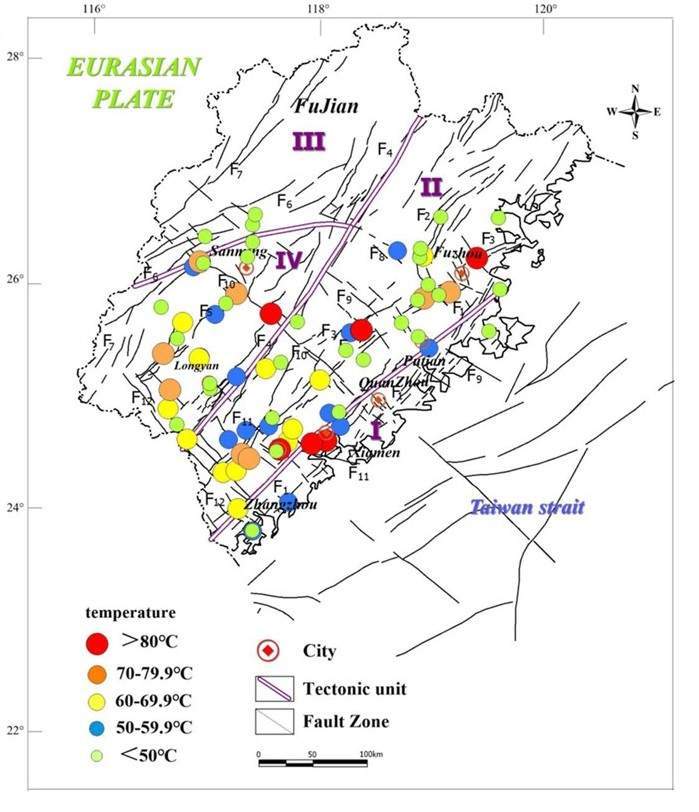
Adapted from Liao et al. (2023), Frontiers in Earth Science. CC BY 4.0
This geology is not incidental to Fujian’s hot spring culture. It is the reason that culture exists. The province’s springs are abundant, geographically distributed, and produce water at moderate, consistent temperatures, characteristics that made large-scale leisure development practical and that continue to shape how hot spring facilities are built and used today.
How the Format Varies Across the Region
The same geological conditions that produce hot springs across East Asia have given rise to distinct facility formats and social practices in each country. Understanding these differences helps set accurate expectations before visiting Fujian.
In Japan, onsen culture is highly structured. Bathing is almost always nude and gender-segregated, with established etiquette around washing before entering pools and soaking quietly. Swimsuits are not permitted in traditional facilities. The experience is calm and ritual-driven, with facilities often located in dedicated onsen towns or rural areas, prioritising atmosphere over scale.
In Korea, the format is urban and multifunctional. Large jjimjilbang complexes combine hot and cold pools, saunas, sleeping areas, dining, and entertainment within a single building. Bathing areas are nude and gender-segregated, while shared relaxation areas use facility-provided clothing. The culture is informal and social, with people visiting for many hours or overnight. The emphasis is on convenience and versatility as everyday urban infrastructure.
In Taiwan, the approach is more relaxed and visitor-directed. Facilities range from compact neighbourhood bathhouses to large outdoor resort parks. Bathing practices vary by facility type: traditional bathhouses use nude, gender-separated bathing while larger outdoor parks often require swimsuits. There are no fixed rituals or schedules. Hot springs function as familiar domestic leisure, closely tied to weekend trips and regional travel.
China, including Fujian, is part of the same regional tradition. Hot spring bathing is a normal, multi-generational leisure activity embedded in how people spend time, not a niche wellness category or a tourist novelty. The specific format that developed in Fujian reflects both the province’s geology and its own leisure patterns.
What Makes Fujian's Hot Springs Distinct
Fujian’s hot spring format has its own defining characteristics that set it apart from the formats described above.
Facilities are typically large-scale outdoor parks set within landscaped environments, foothills, river valleys, or semi-rural areas outside dense urban centres. These parks contain dozens of pools at varying temperatures, landscaped grounds, rest areas, dining options, and often integrated leisure amenities or on-site accommodation. The emphasis is on space, capacity, and visitor-directed pacing. There is no prescribed sequence or schedule. Visitors move between pools and facilities at their own pace, spending as much or as little time as they choose in each area.
Bathing in Fujian’s major outdoor facilities is done in swimsuits, particularly where pools are mixed-gender or designed for families and groups. This makes the experience immediately accessible to international visitors unfamiliar with nude bathing customs elsewhere in the region. Rules are simple and clearly communicated, with minimal ceremony attached.
This format reflects Fujian’s specific geology directly. The province’s granite-hosted fault systems produce springs at moderate, consistent temperatures with clear, non-sulphurous water, characteristics well suited to large outdoor soaking environments and the extended, unhurried visits that define Fujian’s leisure parks. The water quality and temperature range support prolonged soaking in open-air settings across the year.
The Fujian Hot Spring Landscape
Hot spring facilities are distributed across Fujian, with concentrations in Xiamen, Longyan, Zhangzhou, Yongtai, and Liancheng. The provincial landscape includes both large outdoor parks and smaller traditional bathhouses, with quality and facility standards varying significantly across locations.
Most facilities were developed for domestic visitors, with Chinese-language signage, local payment systems, and service models that assume familiarity with bathing culture. This domestic orientation extends to marketing and online presence, with promotional efforts concentrated on local Chinese platforms rather than international booking channels.
For international travellers researching hot spring options in Fujian, the result is a visibility gap. Searching for hot springs in Fujian typically yields sparse English-language results, not because the category doesn’t exist, but because most facilities were not built with international discoverability in mind. They lack bilingual staff, English-language websites, or listings on platforms that overseas visitors typically use for research and booking.
This is not a quality assessment. Many facilities function well for their intended domestic audience. The gap is one of accessibility and visibility, not of quality or abundance. For international visitors, it means that the practically relevant question is not which of Fujian’s many facilities to choose, but which facilities have been designed or adapted to serve overseas visitors, with English support, international payment options, and presence on familiar booking platforms. These represent a smaller subset of the provincial landscape.
Hot Springs Within Xiamen
Xiamen sits within Fujian’s geothermal belt and has its own hot spring facilities, primarily located in the mainland districts of Haicang, Tongan, and Jimei, roughly 20 to 45 kilometres from the city centre. This placement reflects the same geological reality that shapes facility locations across the province: hot springs emerge where fault systems allow geothermal circulation, and large outdoor parks require space unavailable on the densely developed Xiamen Island.
The mainland location means a hot spring visit requires dedicated travel time, typically 30 to 45 minutes by taxi or ride-hailing service from central Xiamen. This makes it a planned half-day commitment rather than an incidental stop.
For international visitors planning a Xiamen itinerary, hot springs are a standard activity option. They occupy the same half-day time block as temple visits, coastal walks, and old town exploration. The difference is mode of engagement: rather than moving through environments and observing, a hot spring visit involves settling into one location and experiencing it through immersion and self-directed time.
For context on how hot springs fit within Xiamen’s broader activity structure, including time blocks and planning logic, see:
For a closer look at what a hot spring visit in Xiamen actually involves and whether it suits your trip:
